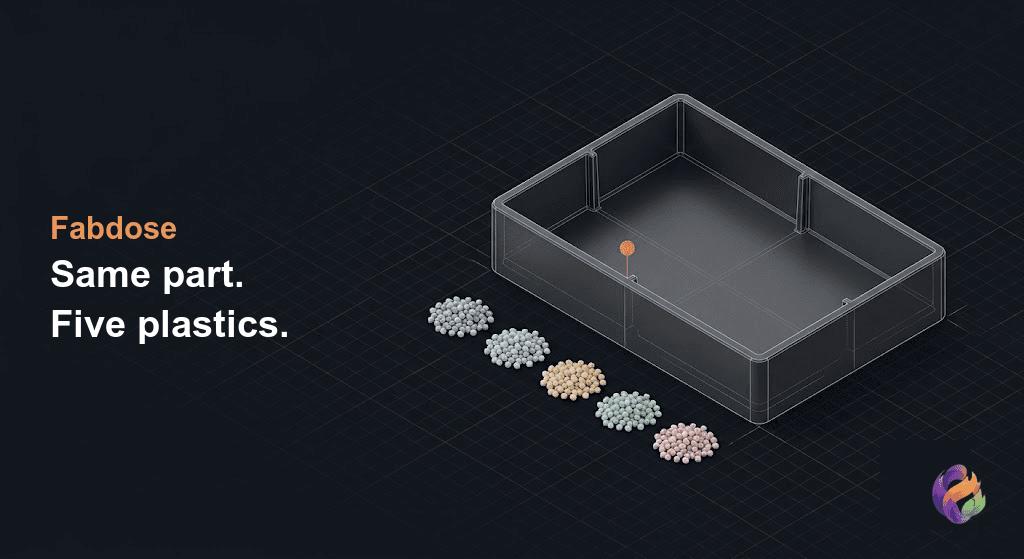
Five runs on one STEP file, with the resin as the only thing I changed between them. The tray is 80 by 50mm, 22mm tall, with side walls that measure 3.20 to 3.27mm, a 3.70mm floor, and every side face drafted at 1.0 degree.
In polypropylene and polycarbonate the tray came back with no wall findings at all. In ABS it came back with 2, both on the floor. In acetal and nylon it came back with 10, covering every wall and both sides of the floor. The file was the same in all five runs, and 12 draft findings appeared in every one of them, the same 12 faces each time.
What was the part, and what changed between runs?
Only the resin. Same file, same process, same settings, five picks from the material list: PP (Polypropylene), PC (Polycarbonate), ABS, POM (Acetal) and PA (Nylon), as the app labels them.
The part is an open storage tray with a flat back. The whole shape forms in the half of the mold that opens upward, and the flat bottom sits on the parting line, which makes the draft direction unambiguous: every side face, inside and out, has to release upward. I drew all of them at 1.0 degree. If the pull direction question is new to you, the mold-open teardown walks through what happens when it is not this obvious.
I set the wall thickness to land between the published ceilings for these five resins: 3.2mm walls are under the ABS, PC and PP limits and over the acetal and nylon ones, and the 3.7mm floor is over every limit except PC and PP.
Which findings stayed the same in all five runs?
Draft. Twelve faces, the four outside walls, the four pocket walls and the four small corner faces of the pocket, reported the same line in every run:
Draft angle 1.0° at face 1 is below minimum 2.0°The tooling estimate did not move either, 1,500 USD at the simple tier every time. It is tiered by geometry, mostly by undercuts and the slide cores they need, and this tray has none.
Which findings moved, and by how much?
Wall thickness, weight and resin cost per part. Every wall finding in these runs is tied to a face number and a position, which is how the table below was counted.
| PP | PC | ABS | POM (acetal) | PA (nylon) | |
|---|---|---|---|---|---|
| Wall ceiling applied | 3.81mm | 3.81mm | 3.56mm | 3.05mm | 2.92mm |
| Wall findings | 0 | 0 | 2, floor only | 10 | 10 |
| Draft findings | 12 | 12 | 12 | 12 | 12 |
| Weight | 27.7g | 35.0g | 30.3g | 41.4g | 32.9g |
| Resin cost per part | 0.030 USD | 0.123 USD | 0.104 USD | 0.125 USD | 0.132 USD |
| Expected yield | 95 to 96% | 95 to 96% | 92 to 93% | 92 to 93% | 92 to 93% |
| Tooling estimate | 1,500 USD | 1,500 USD | 1,500 USD | 1,500 USD | 1,500 USD |
Here is where ABS and nylon part ways, as the engine reported it:
ABS  Wall thickness 3.70mm at face 0 exceeds the 3.56mm maximum for ABS
ABS  Wall thickness 3.70mm at face 14 exceeds the 3.56mm maximum for ABS

PA   Wall thickness 3.70mm at face 0 exceeds the 2.92mm maximum for PA
PA   Wall thickness 3.27mm at face 1 exceeds the 2.92mm maximum for PA
PA   Wall thickness 3.27mm at face 2 exceeds the 2.92mm maximum for PA
PA   Wall thickness 3.27mm at face 3 exceeds the 2.92mm maximum for PA
PA   Wall thickness 3.27mm at face 4 exceeds the 2.92mm maximum for PA
PA   Wall thickness 3.20mm at face 7 exceeds the 2.92mm maximum for PA
PA   Wall thickness 3.20mm at face 9 exceeds the 2.92mm maximum for PA
PA   Wall thickness 3.20mm at face 11 exceeds the 2.92mm maximum for PA
PA   Wall thickness 3.20mm at face 13 exceeds the 2.92mm maximum for PA
PA   Wall thickness 3.70mm at face 14 exceeds the 2.92mm maximum for PA
Faces 0 and 14 are the two sides of the floor, 1 to 4 are the outside walls, and 7, 9, 11 and 13 are the pocket walls. Acetal flags the same ten faces against its 3.05mm ceiling. PP also picks up a low-severity note about its 2.00 percent shrinkage rate, and acetal gets one at 1.80 percent.
The weight column follows density, so the same 29.1 cubic centimeters of tray weighs 27.7g in PP and 41.4g in acetal. Resin cost per part is that weight times a per-kilogram price, which puts PP at under a third of the next cheapest resin here. It covers resin alone, so press time and scrap are outside it, and it is an estimate rather than a quote. The expected yield in ABS, acetal and nylon is the report's own estimate, and it drops when wall findings appear and goes back up when they are cleared, as shown further down.
Why do acetal and nylon get a lower wall ceiling?
Because the resin supplier design guides cap them lower, and the check uses those caps. The guides put recommended walls at roughly 0.76 to 3.05mm for acetal and 0.76 to 2.92mm for nylon. Both resins are semi-crystalline, and the guides explain the lower cap through what a thick section does to a resin that crystallizes as it cools.
A thick section cools slowly in its core. In a crystallizing resin the slow core ends up more crystalline than the skin against the cold steel, so it shrinks more. The skin sets first and the core keeps pulling after it has, which the guides tie to internal voids, warp, and dimensions that keep drifting after the part leaves the mold. ABS and polycarbonate do not crystallize, so their shrinkage depends much less on wall thickness. PP is semi-crystalline as well and its guides still run to 3.81mm, so crystallinity is not the whole story behind these numbers; the ceilings are what the guides publish for each resin.
Is the 2 degree draft flag right for acetal and nylon?
It is stricter than those two resins need. The check holds every injection-molded resin to the same 2.0 degree minimum on smooth surfaces. For ABS, PC and PP that is in line with the guides, which usually recommend 1 to 2 degrees, so a 1.0 degree face there is at the low edge and worth a second look.
Acetal and nylon slide against polished steel with lower friction than ABS or polycarbonate, and supplier guides list smooth-surface draft for them at half a degree or below on shallow draws. The pocket on this tray is about 18mm deep, which I would call shallow. On an acetal or nylon version of this part, I would treat the 12 draft findings as a conservative flag and check them against the resin supplier's guide before adding draft.
What does this comparison not tell you?
How a filled or special grade would read, or what the part will cost to make. The ceilings above are the published values for standard grades, which is what the report lists as the material grade, and a glass-filled acetal or nylon has its own guide. The weights and resin costs are estimates from density and a per-kilogram price. And the draft minimum in the check is set for injection molding as a whole, so it does not change with the resin you pick.
What does it take to clear the wall findings?
Thinner walls, and I reran both fixes to confirm. For ABS the floor only needed to come down, so I redrew it at 3.5mm and left the walls alone. For acetal and nylon I redrew the walls and the floor at 2.8mm.
| Rerun | Wall findings | Draft findings | Expected yield | Weight |
|---|---|---|---|---|
| ABS, floor 3.5mm | 0 (was 2) | 12 | 95 to 96% | 29.6g |
| POM, walls and floor 2.8mm | 0 (was 10) | 12 | 95 to 96% | 34.7g |
| PA, walls and floor 2.8mm | 0 (was 10) | 12 | 95 to 96% | 27.6g |
All three came back clean on walls, with the draft findings unchanged because I did not touch the draft. Thinning to 2.8mm also took about 16 percent of the resin out of the tray in both acetal and nylon.
If you already know which resin your part will be molded in, run the check with that resin selected. If you are still choosing between two, run both and compare the wall findings side by side. Each resin is its own analysis run.
Related reading: how to find the thick spot on a part before it reaches the mold, and draft angles and undercuts, explained face by face.
Check your design with Fabdose
FAQ
Does the choice of plastic change a DFM check on the same part?
Some of it does. On this tray, run five times with only the resin changed, wall findings went from none in PP and PC to 2 in ABS to 10 in acetal and nylon, because each resin is checked against its own maximum wall. The 12 draft findings and the 1,500 USD tooling estimate stayed identical in all five runs.
What is the maximum wall thickness for acetal and nylon in injection molding?
Published design guide ranges run to about 3.05mm for acetal and about 2.92mm for nylon, against about 3.56mm for ABS and 3.81mm for polycarbonate and polypropylene. A thick core in a crystallizing resin cools slowly and shrinks more than its skin, which the guides tie to voids, warp and dimensional drift.
Do acetal and nylon need less draft than ABS?
Supplier guides say they can take less, half a degree or below on shallow draws with polished steel, because of their low friction against steel. The check applies 2.0 degrees to every injection-molded resin, so on acetal or nylon a 1.0 degree flag is a conservative call.
Why did the tooling estimate stay the same across all five resins?
It is tiered by geometry, mainly undercuts and the slide cores they need, and the shape did not change between runs. The tray had no undercuts, so it stayed at the simple tier and 1,500 USD, an estimate for a region and a tier.
Should I run the check again after changing materials?
Yes, when the two resins have different wall limits. A part that is clean in PP can pick up findings in ABS, and more in acetal or nylon, without any change to the CAD.