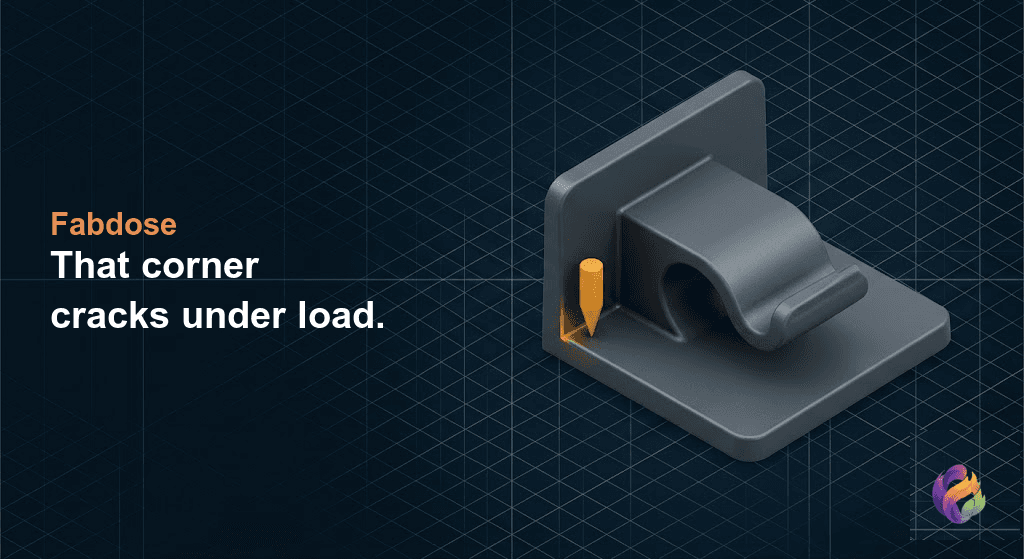
A sharp internal corner is one of the easiest things to leave in a CAD model by accident. Two walls meet at a right angle, nobody adds a fillet to the inside of the joint, and the part looks fine on screen — plastic doesn't show stress the way a rendering shows a dent. It's also one of the most common places an injection-molded part actually fails: not on the mold, not on the quote, but weeks later, when the part cracks at that exact corner under a load that shouldn't have broken it.
We built a representative part to check what changes when that corner gets a fillet, and what changes when it doesn't. The part below is a synthetic, illustrative model built for this post, not a real customer file: a small mounting tab meeting a base wall at a right angle, the kind of feature that shows up on cable clips, snap-fit arms, and enclosure ribs across a lot of injection-molded consumer hardware. We ran it through fabdose twice, changing only the radius of the fillet at the inside of that corner.
What makes an internal corner a stress riser in the first place?
Plastic is highly notch-sensitive, and a sharp internal corner is a notch. When hot resin cools inside a mold, it shrinks. At a sharp corner, that shrinkage happens against unyielding steel with nowhere to relax, so residual stress concentrates right at the corner instead of distributing across the wall. On top of that, two walls meeting at a right angle create a locally heavier mass of material than either wall alone — the corner is thicker than its neighbors, so it cools slower and shrinks differently from the surrounding plastic. Any crack that starts almost always starts here, because this is where the part is simultaneously weakest and most stressed.
What did fabdose actually measure on the two versions of this part?
The sharp version's corner fillet measured a 0.12 radius-to-wall ratio against a 0.50 minimum; the filleted version measured 0.58, and cleared it. In the first run, the corner carries a small but real fillet, radius 0.3mm, against a wall around 2.5mm thick — a ratio of 0.12. Fabdose flags it directly: "sharp internal corner concentrates stress, initiating brittle crack under load," severity high, located at the specific fillet face at the root of the tab. In the second run, nothing else about the part changed — same tab, same wall, same overall geometry — except the fillet radius grew to 1.5mm, putting the ratio at 0.58, above the 0.50 floor. That run returns zero brittleness risks. One radius change, and the exact same corner goes from flagged to clean.
Does adding that fillet show up in the tooling quote?
No — and that's what makes this defect easy to miss even when a quote comes back clean. In fabdose's cost model, both versions of this part priced identically: same base tooling tier, no added mold mechanisms, no line-item difference. A fillet is a change to the core and cavity steel that was already being cut either way, not a new mechanism like a slide core, so it doesn't move mold complexity the way an undercut does — the kind of cost jump we've shown before when a feature adds a slide. The cost of a corner too sharp to survive its load case doesn't show up on the tooling quote at all. It shows up later — in parts that crack during ejection, in field returns, in a warranty line — which is exactly the kind of cost a pre-tooling geometry check is supposed to catch before it becomes one.
Does fabdose catch every corner, or just some?
Only concave corners with a real, measurable fillet — not every rounded edge on a part. Stress concentration is specifically a concave-corner problem: a convex, outward-rounded corner doesn't create the notch that a load-bearing internal corner does, so fabdose doesn't flag those. It's also worth being precise about what a zero-radius corner with no fillet modeled at all gets: nothing, because there's no fillet surface for the tool to measure a radius on in the first place. This check catches corners that were filleted too small, which is the far more common real-world case — almost nobody leaves a mathematically sharp edge in production CAD, but a lot of parts have a fillet that's rounded enough to look fine and still too small to do its job. There's a second, published piece of DFM guidance this teardown doesn't check: matching the outside of a corner to the inside radius plus the wall thickness, to keep the corner's local mass close to nominal. Fabdose's check is on the inside radius-to-wall ratio only; it doesn't verify outside-corner uniformity.
How do you check whether your own part has this problem before tooling?
By checking every internal fillet's radius against its adjacent wall thickness, face by face — the same face-by-face method we've walked through on a real open-source bracket and on a groove wall's draft angle. A too-small fillet is an easy miss in a visual review, because it still reads as "rounded" at a glance — the difference between a 0.12 ratio and a 0.58 ratio is not something most people can eyeball on a screen. Sharp corners are one of a handful of injection molding defects that don't show up in a static CAD render at all until the part is actually molded or loaded. Fabdose reads your STEP or STP file on your own computer and locates each internal fillet by its face ID, its measured radius, and its ratio against wall thickness, before the file goes out for a quote.
Check your design with Fabdose
FAQ
Why does a sharp internal corner concentrate stress in an injection-molded part?
Plastic is notch-sensitive: at a sharp internal corner, polymer chains can't smoothly change direction during cooling, so molded-in stress concentrates there instead of spreading across the wall. The corner is also geometrically thicker than either wall meeting there, so it cools slower and shrinks differently, adding more stress on top.
What fillet radius to wall thickness ratio avoids this?
At least 0.5 times the adjacent wall thickness is the standard floor; below that ratio, stress concentration climbs sharply. 0.6 to 0.75 is the commonly cited target for extra margin.
Does skipping the fillet show up in the tooling quote?
No. In this teardown, the sharp and filleted versions of the same part priced identically — a fillet doesn't add a mold mechanism, so it doesn't move the quote. The cost shows up later, in cracked parts and warranty claims, not before tooling.
Does fabdose check every rounded corner, or just some?
Only concave (internal) fillets with a measurable radius — convex corners aren't stress risers, and a corner with no fillet surface modeled at all has nothing to measure. It doesn't check the published "outside radius = inside radius plus wall thickness" uniformity rule.
How do you check whether your own part has this problem before tooling?
Check every internal fillet's radius against its adjacent wall thickness, face by face. Fabdose reads your STEP or STP file on your own computer and locates each internal fillet by face ID, measured radius, and ratio against wall thickness, before the file goes out for a quote.
Fabdose is a desktop tool for checking STEP and STP files against injection molding design rules. It locates internal fillets face by face and flags any radius-to-wall-thickness ratio below the 0.5 stress-concentration threshold, before the file goes out for a quote. It does not run finite-element stress analysis, does not predict when or whether a given part will actually crack, and does not check outside-corner uniformity. Your CAD geometry is processed on your own computer; defect findings and descriptions are processed by AI. The part in this post is a synthetic, representative model built to demonstrate the mechanism, not a real customer file; the cost figures are fabdose's built-in estimates, not a shop quote.