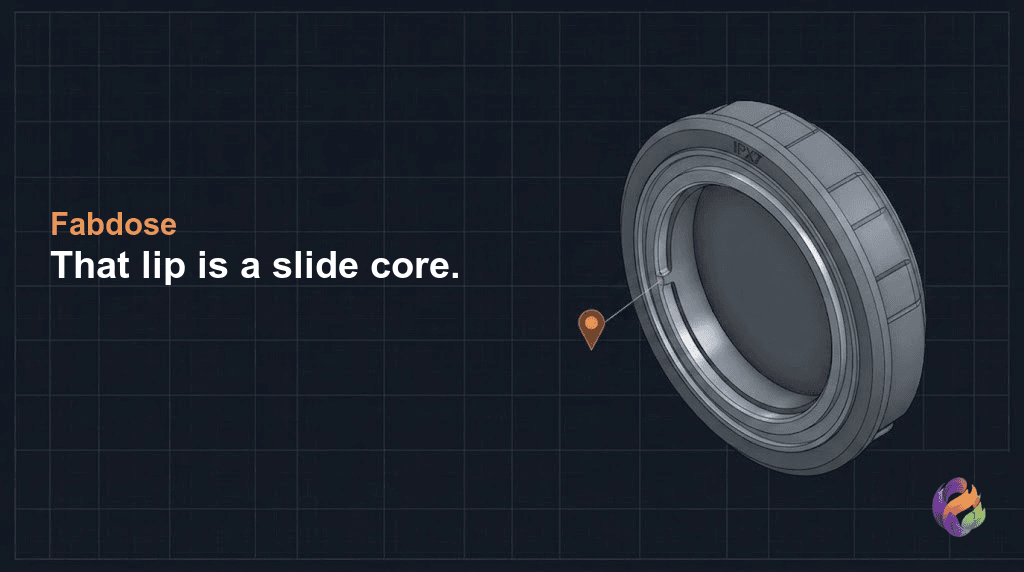
A recent product-design discussion turned on a waterproof enclosure lid: how much the O-ring in its groove should compress, how full the groove should sit, and whether it would hold at the depth rating the product needed. Underneath those questions sat a smaller, easier-to-miss one: should the groove have a small lip at its opening to keep the O-ring from falling out while the enclosure is being assembled? It sounds like a helpful, low-risk detail. Whether it stays low-risk depends entirely on which direction the mold pulls.
We built a representative version of that lid to check. The part below is a synthetic, illustrative model built for this post, not a real customer file, so the mechanism is easy to see: a circular lid with an O-ring groove machined into the mating face, run through fabdose twice with only one change between the two runs, once with a straight-pull groove and once with a small retention lip added at the mouth.
What makes an O-ring groove wall a straight-pull feature in the first place?
A groove wall releases cleanly when it never gets narrower than the opening above it, in the direction the mold pulls. Picture the steel that forms the groove as a thin ridge standing up from the mold's core side. For that ridge to pull straight out after the shot, every point along it has to be at least as wide, or wider, than the opening it passes through on the way out. Give the ridge a slight taper so the groove is a touch wider at the mouth than at the floor, and it slides free without touching the walls it just formed. That taper is draft, and for a shallow feature like a sealing groove, a few degrees is usually enough. In the compliant version of this lid, the groove walls carry 5 degrees of taper, and fabdose reads them at exactly that: 5.0-degree draft, not an undercut, on both groove side-wall faces.
What happens when a small lip is added at the groove's mouth?
The lip reverses the relationship the straight pull depends on, and it does not need to be large to do it. In the second version of this lid, the last half-millimeter of the groove before the opening steps inward, narrowing the mouth to about two-thirds of the floor width. That half-millimeter step is enough: fabdose flags it as a critical undercut on both groove walls, reporting "critical undercut, requires complete redesign or advanced mold technique" on the two faces the lip creates. The same run also shows the vertical groove walls reading exactly 0 degrees of draft, because removing the taper to fit the lip in removed the draft along with it. Nothing else about the lid changed between the two runs. The lip is the entire difference, and it shows up as two new undercut faces plus a lost draft angle, located exactly where the lip sits.
What does that undercut actually cost in tooling?
In fabdose's built-in cost model, the straight-pull version of this lid priced at $1,500 in base tooling with no added mechanisms. The lip version priced at $13,000. Two things moved. First, the mold's complexity classification stepped up from simple to medium once the undercuts were present, which alone raised the base tooling estimate from $1,500 to $5,000. Second, two slide cores were added at $4,000 each, one for each undercut face the lip created, bringing the total to $13,000. That figure is a built-in estimate produced from the geometry, the same kind of static cost signal we've described before as an estimate and not a real shop quote, but the mechanism it is pricing is real: two retracting slide cores instead of a straight-pulling core, on a feature that is otherwise a couple of millimeters of channel.
Is there a way to keep the O-ring seated without creating that undercut?
Usually, yes, and the fix is to rely on the seal's own squeeze instead of adding a mechanical lip. A groove sized correctly for its O-ring already compresses the ring against the groove walls enough that it grips and stays put through normal handling, which is the assumption most O-ring groove designs run on without any retention feature at all. If a particular ring is unusually soft or the assembly step is rough enough that squeeze alone is not enough, the straight-pull-friendly move is to keep any retention feature shallow and rounded rather than a sharp step, and check the depth against the resin's strippable-undercut ceiling, the same limits we walked through for stripped undercuts generally — a small, rounded lip within that ceiling can sometimes be pushed off the core during ejection instead of needing a slide at all. A sharp 90-degree step, like the one in this teardown, is outside that ceiling on almost any resin.
How do you check whether your own groove design creates an undercut?
By checking the groove walls face by face against the mold's pull direction, which is the same check that catches an undercut anywhere else on a part — the kind of face-by-face read we walked through on a real open-source bracket. A sealing groove is an easy place for this to slip past a visual review, because a retention lip looks like a feature that is helping, not one that is changing the mold. Fabdose reads your STEP or STP file on your own computer and locates each undercut and each insufficient-draft face by its specific face ID, including a groove wall like the one in this lid, before the file goes out for a quote. It is worth being precise about what it does not do: fabdose does not size an O-ring or check squeeze ratio or groove fill percentage, the elastomer-sizing math that decides how much the ring should compress in the first place. That is a separate calculation from whether the groove geometry releases from a straight-pull mold, and it is the second question this teardown is about.
Check your design with Fabdose
FAQ
Is a small retention lip on an O-ring groove an undercut?
Yes, if it makes the groove narrower at the mouth than at the floor. An undercut is defined by whether a feature blocks the part from ejecting straight along the pull direction, and a lip that steps inward at the opening does that regardless of how small it is. A fraction-of-a-millimeter lip creates the same shadowing relationship a deep undercut does.
Why does a retention lip need a slide instead of releasing on a straight pull?
Because the mold steel forming the groove floor sits behind the lip relative to the pull direction, so pulling it straight out would drag it through solid plastic. The only way to still form the feature is to give that steel a retracting motion of its own, typically a side-action slide.
What does adding that slide actually do to mold cost?
In fabdose's cost model, the straight-pull version of this lid priced at $1,500 with no added mechanisms. The lip version priced at $13,000: mold complexity moved from simple to medium (base tooling $1,500 to $5,000), plus two slide cores at $4,000 each, one per undercut face.
If you need to keep the O-ring seated during assembly, what's the alternative?
Lean on the O-ring's own squeeze, which most groove designs already rely on without any retention feature. If a lip is still wanted, keep it shallow and rounded rather than a sharp step, and check it against the resin's strippable-undercut limits.
How do you check whether your own groove design creates an undercut?
Check the groove walls face by face against the mold's pull direction. Fabdose reads your STEP or STP file on your own computer and locates each undercut and insufficient-draft face by its specific face ID, including groove walls, before the file goes out for a quote. It does not size the O-ring or check squeeze/fill percentage.
Fabdose is a desktop tool for checking STEP and STP files against injection molding design rules. It locates undercuts and draft-angle violations face by face, before the file goes out for a quote. It does not quote jobs or sell manufacturing, and it does not size elastomer seals or check O-ring squeeze or groove fill percentage. Your CAD geometry is processed on your own computer; defect findings and descriptions are processed by AI. The lid and groove geometry in this post are a synthetic, representative model built to demonstrate the mechanism, not a real customer file; the cost figures are fabdose's built-in geometry-based estimate (Korea tooling region), not a shop quote.