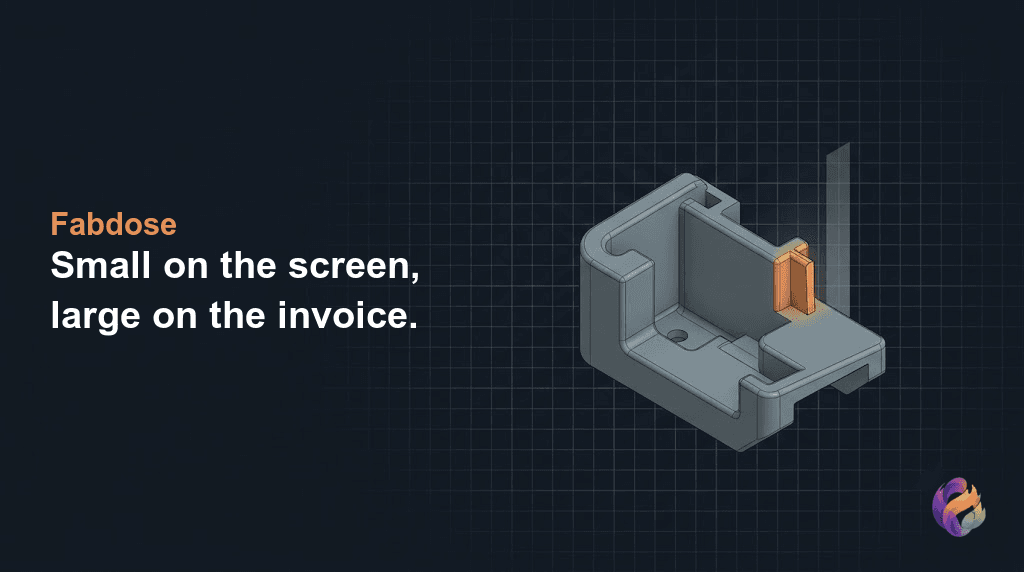
When your injection molding quote comes back far higher than you expected, the cause is often not the whole part. It is one detail. And the reason one small detail can move the number so much is that the detail changes the mold, not just the part — an undercut needs a moving mechanism to release, a zero-draft face drags during ejection, a thick section slows the entire cycle — and each of those is priced into the tool and the per-part cost before you ever see the figure.
This is the situation a product designer in r/manufacturing walked into recently. They had a part with "little triangle-shaped protrusions that come out .6mm" and asked whether it could be made. The replies were blunt: "yes but expensive," the "additional cost you will incur with that design will be astronomical," and — the useful part — "collaborate with a machinist or manufacturing engineer on that feature before the engineering drawing goes out for quote." A 0.6 mm feature, an astronomical cost delta. That gap between how small the detail looks and how large it prices is the whole subject of this post.
Why does one detail change the price so much?
Because an injection molding quote is really two prices stacked together: the cost of cutting the mold, and the cost of every cycle the mold runs. A single geometry detail can push on either one. Add an undercut and you have changed what the tool has to be. Remove the draft from a face and you have changed how every shot ejects. The part looks the same in CAD; the mold does not.
Here is the short version of which details cost what, before we go feature by feature.
| Design detail | What it does to the mold or cycle | Rule of thumb to stay cheap |
|---|---|---|
| Undercut (side hole, clip, thread, recess off the pull direction) | Locks the part onto the steel; forces a moving mechanism (slide, lifter, collapsible core, unscrew) | Redesign to a straight pull, or form the feature with bypass steel where the mold halves meet |
| Zero or low draft on faces parallel to the opening | Part drags on the steel during ejection: drag marks, warp, or slower cycles and mold-release steps | Minimum ~1 degree draft on common resins (ABS, PC); 0.5 degree absolute minimum; more for texture and depth |
| Non-uniform or thick walls | Cooling time rises with the square of the thickest wall; sink marks, warp, longer cycles | Keep walls uniform, roughly 1.0 to 3.5 mm for ABS; ribs 40 to 60 percent of the wall thickness |
| Tolerances tighter than needed | Mold must be machined to a fraction of the tolerance band by slow, precise methods | Use standard commercial tolerances (about plus or minus 0.1 to 0.2 mm up to 100 mm) unless function demands tighter |
What is an undercut, and why is it the classic quote-killer?
An undercut is any feature — a side hole, a clip, a thread, a recess — that sits across the direction the mold opens, so a simple two-part straight-pull mold physically cannot separate without tearing the feature off the part. The moldmaker's fix is to build a moving component into the tool: a side-action slide, a lifter rail, a collapsible core, or an unscrewing mechanism that retracts before the part ejects.
That is where the money goes. A moving mechanism is extra steel, extra fitting, and a moving wear point that adds long-term maintenance. It also eats space: a side-pull typically needs an extra clearance of about 7.5 cm added to the mold plate per slide, and three or more side-pulls usually push the tool down to a single cavity — which raises the cost of every part you ever mold. This is why moldmakers, given the choice, will tell you to "avoid undercuts with a passion." The cheapest undercut is the one redesigned away — often by giving the feature a through-hole, or by letting bypass steel from the opposing mold half form the opening in a straight pull.
Why does a face with no draft cost you?
Draft is the slight taper on faces that run parallel to the mold's opening direction. It exists because of a physical fact: as the plastic cools, it shrinks away from the outer cavity walls but grips tightly onto the internal cores. Without a taper, the part scrapes along the steel for the entire ejection stroke. The results are drag marks, warpage, or in the worst case ejector pins that stress-whiten or punch through the part.
To keep a zero-draft face working, molders resort to slower cycles, lower packing pressure, or mold-release sprays — all of which drive up the per-part cost. As a rule of thumb, most common unfilled resins such as ABS, PC, and PC/ABS want a minimum of about 1 degree of draft, with 0.5 degree as an absolute floor for shallow features. Textured surfaces need more — roughly an extra 1 degree per side for every 0.001 inch of texture depth — and soft TPU grades can need up to 5 degrees. A vertical wall left at zero draft is the single most common finished-looking detail that quietly taxes every shot.
Why do thick or uneven walls slow everything down?
Plastic is a good thermal insulator, so a molded part cools from the outside in as the steel draws heat away. The cooling time is proportional to the square of the heaviest wall thickness — double the thickest section and you roughly quadruple the time each part needs in the tool. Thick sections also shrink last: as the molten core finally contracts, it pulls on the already-solid skin and leaves a sink mark on the show face, or an internal void.
Uneven walls make it worse, because thin areas lock their dimensions while thick areas are still fluid, which invites warp. The fix is uniform walls in the material's recommended range — roughly 1.0 to 3.5 mm for ABS, a little thinner for polycarbonate, wider for polypropylene — with ribs kept to about 40 to 60 percent of the nominal wall thickness so they add stiffness without printing a sink mark through the surface. None of this always raises the tooling price, but it raises cycle time and therefore the cost of every part.
Why is "before the drawing goes out for quote" the important part?
Because the price of fixing a detail changes completely the moment the steel is cut. Before the mold exists, an undercut or a missing draft angle is a CAD edit — an afternoon. After the mold is cut, the same fix means re-machining a tool, welding metal back into steel, or paying for a new mold. The person in that r/manufacturing thread got the right advice: get the manufacturability read on the specific feature before the file goes out, and you avoid both the astronomical cost delta and the no-quotes.
The catch is where you get that read. The obvious option is to send the file to a shop and let their free DFM check flag it. That is genuinely useful and worth doing — but it comes from the party that quotes and profits from making the part, so it has a structural reason to tell you the design is fine as drawn and little reason to suggest a cheaper redesign or a different process. That is not about vendors being dishonest; it is about who profits from which answer.
How do you read the geometry yourself, first?
Undercuts, draft, and deep blind pockets are deterministic from the geometry alone, which means they can be located without a factory in the loop. That is what Fabdose does: it reads your STEP file on your own computer, before you send it anywhere, and locates each undercut, zero-draft face, and deep blind pocket down to the specific face, the exact place the mold would fight you. Pockets are judged on their depth-to-opening ratio, with venting assumed absent, since a STEP file does not show it. Flow-dependent defects like weld lines and flow-front air traps depend on gate placement and cooling, so a geometry check flags them as risks rather than pinning them to a face; those still need a shop's DFM review or a flow simulation.
Fabdose also shows a built-in static cost signal so you can see which features are moving the number. That signal is an estimate produced from the geometry, not a real shop quote — the point is not to replace the shop's price, but to tell you which one small detail is doing the damage while the fix is still a CAD edit. And because Fabdose does not quote jobs or sell manufacturing, its read has nothing riding on the answer. That is the one thing a shop's free check, by its nature, cannot offer: a manufacturability read from a party with no job to sell.
The 0.6 mm triangle in that thread was worth catching before the drawing went out. Most expensive quotes have a detail like it — small on the screen, large on the invoice. Reading the geometry first is how you find it while it is still cheap to fix.