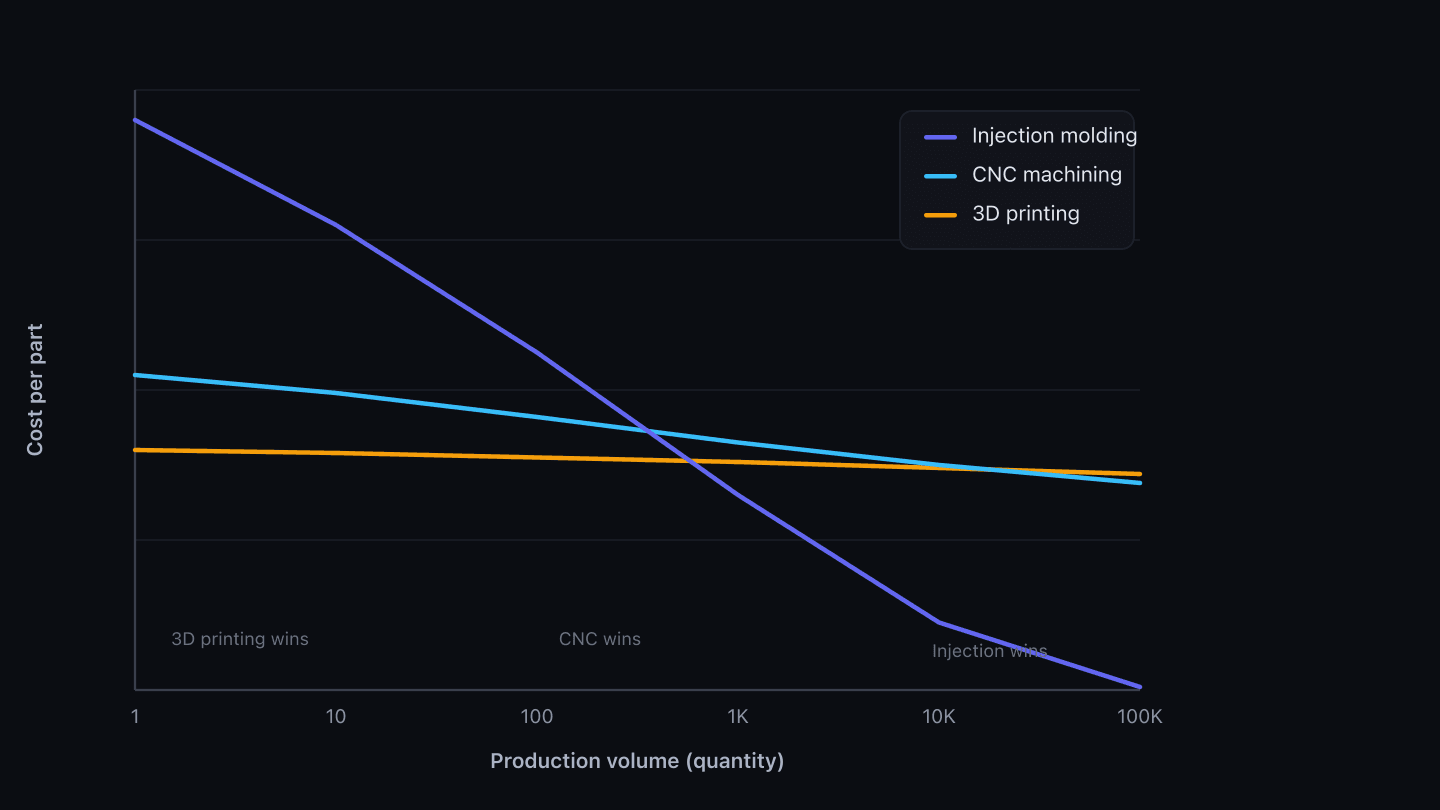
The most common process selection mistake product designers make is choosing based on what they already know. If you have always used CNC, you quote the part in metal. If the previous product used injection molding, the new one gets the same process. The result is a part that works but costs three times what it should, or one that hits a geometry wall late in development.
Here is the practical answer: no single process wins. The right choice depends on four variables — how many units you need, what geometry your design actually contains, what material properties the part must have, and how much tooling cost you can absorb up front. This guide walks through each major process on those axes so you can make the call early, when it still affects the design rather than just the budget.
What is the difference between injection molding, CNC machining, and 3D printing?
Injection molding, CNC machining, and 3D printing each produce physical parts through fundamentally different mechanisms. Injection molding forces molten material into a mold — high volume, low per-part cost, strict geometry rules. CNC machining removes material from a solid block — flexible geometry, high precision, no tooling cost, higher per-part cost. 3D printing builds parts layer by layer — no tooling, almost no geometry constraints, weaker material properties at volume. The right choice depends on production volume, geometry, material, and tooling budget.
The four processes at a glance
Injection molding forces molten plastic into a steel or aluminum tool under high pressure. It produces high volumes at very low per-part cost, but the tooling investment is significant and the geometry must conform to strict rules: uniform wall thickness, adequate draft on all pulled faces, and no features that trap the mold as it opens.
CNC machining removes material from a solid block using rotating cutters. It reaches tight tolerances on almost any geometry a cutter can physically reach, handles metals and engineering plastics equally well, and requires no tooling investment. The cost per part is higher and scales linearly with complexity. Material waste can be substantial.
3D printing (including FDM, SLA, and SLS) builds parts layer by layer with no tooling cost and almost no geometry constraints. It excels at low volumes and complex internal or external geometry. The tradeoffs are weaker and more anisotropic material properties versus the same material machined or molded, coarser surfaces in most cases, and per-part costs that do not drop significantly at volume.
Die casting is the metal equivalent of injection molding: molten aluminum or zinc is forced into a steel die at high pressure. It produces strong, dimensionally consistent metal parts at high volume. Tooling cost is even higher than injection molding, and the geometry rules are similar — draft, uniform wall, controlled undercuts.
The comparison table
| Injection Molding | CNC Machining | 3D Printing (SLA/SLS/FDM) | Die Casting | |
|---|---|---|---|---|
| Volume sweet spot | 10,000+ units | 1 to ~5,000 units | 1 to ~500 units | 10,000+ units |
| Tooling cost | $3,000 to $80,000+ | None | None | $10,000 to $150,000+ |
| Per-part cost at volume | Very low ($0.50 to $5) | Medium to high | Medium ($5 to $100+) | Very low (similar to IM) |
| Tolerance | +/- 0.1 to 0.25 mm typical | +/- 0.01 to 0.05 mm | +/- 0.1 to 0.5 mm typical | +/- 0.1 to 0.2 mm typical |
| Surface finish | Excellent (tool finish) | Excellent (machined) | Varies — SLA best, FDM visible layers | Excellent with secondary ops |
| Primary materials | Engineering thermoplastics | Metals, plastics, composites | Resins, nylons, photopolymers | Aluminum, zinc, magnesium |
| Geometry freedom | Constrained (draft, wall, undercuts) | High (tool access limits) | Very high | Constrained (similar to IM) |
| Lead time (first part) | 4 to 12 weeks (tool build) | Days to weeks | Hours to days | 6 to 16 weeks (die build) |
Where each process breaks down
Injection molding geometry rules
Injection molded parts must satisfy three geometric conditions that are non-negotiable if you want consistent, defect-free parts.
Draft angles — every face that is parallel or close-parallel to the mold opening direction needs at least 1 to 3 degrees of taper. Without draft, the part grips the tool on ejection, causing surface damage and ejection failures. Textured surfaces need more draft, often 3 to 5 degrees, because the texture mechanically interlocks with the tool steel.
Uniform wall thickness — significant thickness variation causes differential cooling rates, which creates sink marks on visible surfaces, warpage of the overall part, and internal voids. The standard target is walls within 25% of each other. Ribbing instead of thick sections is the typical fix.
Undercuts — any feature that prevents the tool from opening in a straight pull direction requires a side-action (a moving tool element that slides out before the mold opens), which adds significant tooling cost and complexity. Internal undercuts are even harder to address.
CNC geometry rules
CNC can reach almost any geometry, but access matters. Deep pockets with small radii require long, thin tools that deflect and break. A 10 mm deep pocket with a 0.5 mm corner radius is technically possible on a high-end machine with special tooling, but it is expensive and slow. The practical rule is to keep floor radii to at least 1 mm and avoid aspect ratios (depth-to-width) above 4:1 in pockets unless you have verified your shop can hold it.
Five-axis machining expands access significantly, but also expands cost. If your part needs undercutting or compound curves, CNC can often handle it — at a price.
CNC also wastes material. A complex aluminum part machined from billet can produce 80% or more scrap by weight. For expensive materials this matters.
3D printing limitations
The layer-by-layer build process introduces anisotropy: printed parts are weaker in the Z-axis (build direction) than in the XY plane. For structural parts under load this matters — the part may pass a static strength test in one orientation and fail in service under a different load direction.
SLA (resin) produces smooth surfaces and fine features but parts are brittle and UV-sensitive unless post-cured and coated. SLS (nylon) produces stronger, more isotropic parts and handles complex geometry including internal channels. FDM is cheapest but leaves visible layer lines and has the most pronounced anisotropy.
At low volume — prototypes, jigs, custom housings, one-off functional parts — these limitations are acceptable. At production volume they are not.
Insight
The geometry rules for injection molding and die casting are almost identical in concept: both need draft, both punish undercuts, both reward uniform wall thickness. The difference is material — plastic vs. metal — and the cost and complexity of the tooling.
How to decide in practice
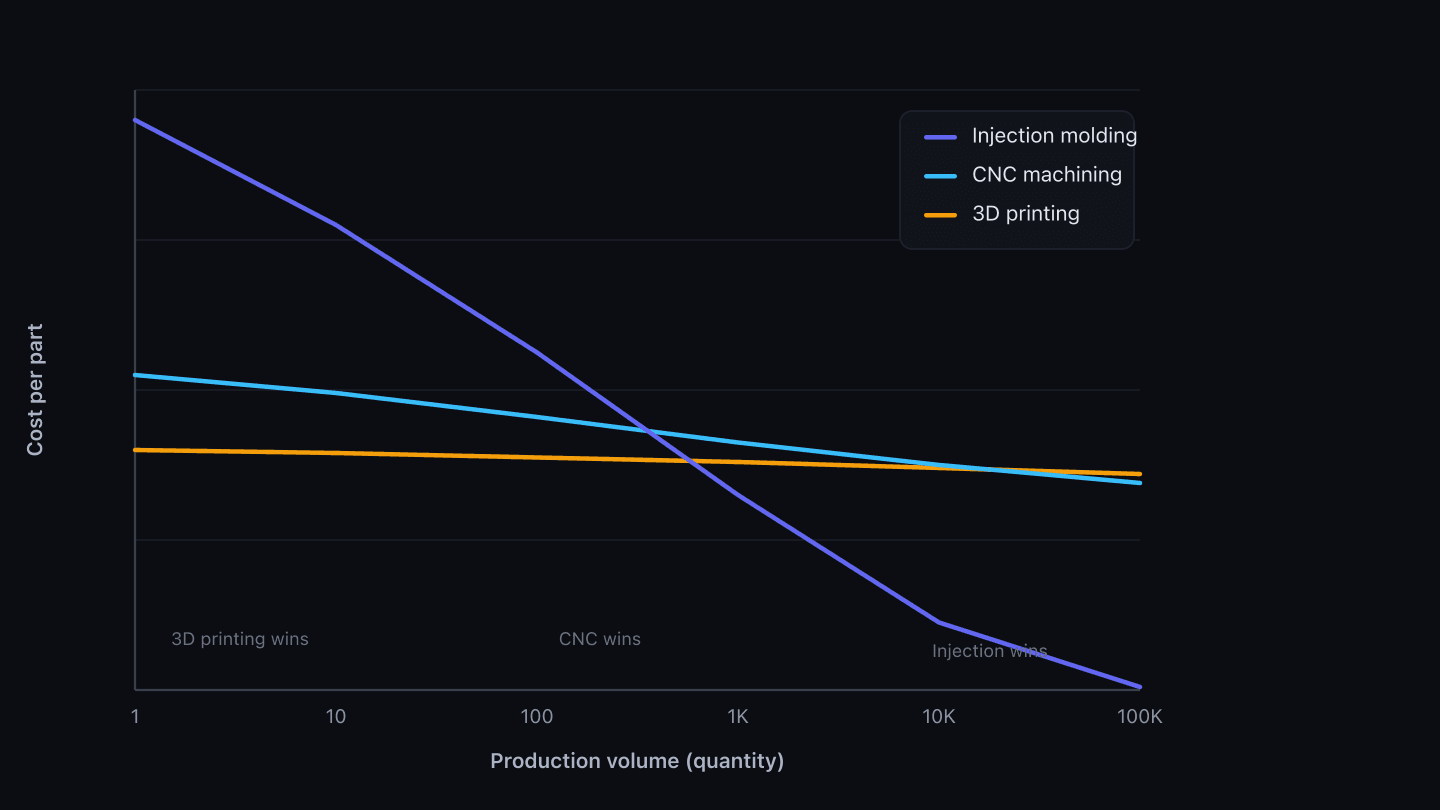
Start with volume. If you need fewer than 500 units, the tooling cost of injection molding almost never amortizes. CNC or 3D printing is the answer for prototypes and initial production. If you need more than 10,000 units of a plastic part, injection molding's per-part cost advantage eventually outweighs the tooling investment — usually somewhere between 2,000 and 5,000 units depending on part complexity and material.
Then check your geometry. If your design has features that violate draft or uniform-wall rules for injection molding, you have three choices: redesign the part, switch to CNC, or accept side-actions in the tool. The choice depends on whether those features are essential to the product function.
Material is often the deciding factor for metal parts. If you need structural aluminum or zinc, you are choosing between CNC (low volume, high tolerance) and die casting (high volume, moderate tolerance). For plastic structural parts, glass-filled nylons and engineering resins available in injection molding generally outperform what is achievable with 3D printing.
Tip
Lead time cuts both ways. CNC and 3D printing get you first parts in days. Injection molding and die casting require 4 to 16 weeks of tool build before you see a single part. If your design is still changing, starting a tool build is expensive timing risk.
The geometry check you can run before committing
The geometry rules above — draft, wall thickness, undercuts — are checkable before you send drawings to a shop. You do not need a manufacturing engineer to flag most of them. You need software that can open your STEP file and measure those conditions directly from the geometry.
The same STEP file can be checked against injection molding, CNC, die casting, and 3D printing constraints to see which processes your geometry actually fits today. Checking one process per analysis is part of the free tier; the side-by-side auto-comparison across processes at once is a Pro feature. Either way, you are not guessing which rules you might be violating, you are seeing the specific faces and features that would cause problems.
Fabdose is a local-first desktop app for Mac that does this. You load a STEP or STP file, the analysis runs in one to three minutes on your computer, and you get a process-by-process report: draft violations and undercut locations pinned face by face in a 3D viewer, a part-wide wall-thickness read (a variation-based warp-risk flag, not a per-face pin), and a cost-range estimate per process. Your CAD files are never uploaded — they stay on your computer, and only the defect findings are processed by AI and synced to your account. The first five analyses are free, no credit card required.
It does not replace a manufacturing engineer and it does not generate supplier quotes. What it does is tell you, before you talk to anyone, which of these four processes your current geometry is compatible with.
Frequently asked questions
When does injection molding become cheaper than CNC per part?
Injection molding becomes cheaper than CNC on a per-part basis somewhere between 2,000 and 5,000 units for most plastic parts, depending on part complexity and material. Below that range, the tooling cost — typically $3,000 to $80,000 for a mold — does not amortize. Above it, injection molding's per-part cost of $0.50 to $5 makes CNC's linear per-part cost uncompetitive.
What geometry issues disqualify a design from injection molding?
Three issues are most common: insufficient draft angle (faces parallel to the mold opening direction need at least 1 to 3 degrees of taper), significant wall thickness variation (walls should be within 25% of each other to prevent sink marks and warpage), and undercuts (features that block the mold from opening in a straight pull). Each of these can be addressed through design changes or tooling additions, but they add cost and complexity if not caught early.
Can the same STEP file be used for both CNC and injection molding quotes?
Yes. A STEP file is a neutral geometry exchange format that most manufacturing services accept. The same file can be sent to a CNC shop and an injection molding supplier. The manufacturability constraints differ by process, so the feedback will differ — which is also why checking a STEP file against multiple process rules before quoting is useful.
How does die casting compare to injection molding?
Die casting uses the same general approach — forcing molten material into a die under pressure — but with metals (aluminum, zinc, magnesium) instead of plastics. The geometry rules are similar: draft angles, uniform wall thickness, and controlled undercuts apply to both. Tooling cost for die casting is higher than injection molding, typically $10,000 to $150,000 or more. Die casting is the right choice when you need metal parts at high volume with good dimensional consistency.
Is 3D printing suitable for production parts?
3D printing is suitable for production parts at low volume, typically up to a few hundred units, for parts where the structural limitations are acceptable. SLS (nylon) produces stronger, more isotropic parts than FDM and is used in some production applications. At higher volumes, the per-part cost does not drop significantly and material properties remain weaker than equivalent injection-molded or machined parts. The primary production use cases are custom, complex, or low-volume parts where tooling cost cannot be justified.
Analyze your STEP file on your computer. Your CAD file is never uploaded.
Download Fabdose Free