Product designers working on physical parts face a question that comes up early in every review cycle: is this geometry manufacturable? And more and more, the first place people turn is ChatGPT.
The honest answer is that ChatGPT is genuinely useful for DFM education and can help you think through design rules. But it cannot analyze your actual STEP file. Understanding why that distinction matters will save you from getting false confidence at the worst possible time.
What is a STEP file analysis for manufacturability?
A STEP file analysis for manufacturability is a geometric computation that reads a CAD file's B-rep topology, measures dimensional properties — wall thickness, face normals, fillet radii — and checks those values against process-specific constraints. It requires a geometry kernel that can reconstruct and traverse the actual 3D shape, not a text-processing model.
What ChatGPT can do
If you describe a part feature in text, ChatGPT will give you solid DFM feedback. Ask about minimum wall thickness for CNC milling, and it will cite reasonable rules of thumb (typically 0.8 mm for aluminum, 1.5 mm for plastics). Ask about undercuts and it will explain why they require side-actions or EDM. Ask about draft angles and it will give you the 1-3 degree range that most injection molding processes expect.
This is genuinely valuable. ChatGPT has absorbed a large body of manufacturing knowledge from technical documents, engineering forums, and textbooks. For someone learning DFM or needing a quick sanity check on a design rule, it is a useful starting point.
You can also upload an image of your part, and ChatGPT will visually describe what it sees. If you share a rendering or a photo, it can sometimes identify obvious features and comment on them.
What ChatGPT cannot do
ChatGPT cannot open a STEP file and analyze the actual 3D geometry.
This is not a product limitation that might change in a future release. It is structural. ChatGPT is a language model. It processes text and images. A STEP file is a geometric database containing precise coordinate data, B-rep topology, surface normals, and tolerance information. Analyzing it for manufacturability requires a geometry kernel that can traverse that topology, compute measurements, and evaluate geometric conditions against process constraints.
When you paste a STEP file's text content into ChatGPT, you are feeding it AP203 or AP214 entity definitions. ChatGPT will try to interpret the text, but it has no ability to reconstruct the 3D geometry from those definitions, estimate wall thickness from the part's shell, detect undercuts relative to a pull direction, or measure fillet radii from the parametric surface data.
What you get back is a plausible-sounding response based on the text patterns in the file, not a geometric analysis.
The gap in practice
Here is what the difference looks like on a real part.
Suppose you have a CNC-machined aluminum bracket with a pocket that has a small flat floor radius. In text, you might describe it as "a pocket with a 0.5 mm corner radius at the bottom." ChatGPT will correctly flag this as a potential issue because standard end mills have a minimum radius floor clearance.
But if you have that bracket as a STEP file and want to know whether any floor radius falls under 0.8 mm, you need geometric computation. You need software that can read the B-rep data, measure the actual fillet radii, compare them against a threshold, and flag the part with a visual marker on the geometry.
ChatGPT cannot do any of that. It cannot measure anything from the file geometry because it never reconstructed the geometry in the first place.
The same gap applies to:
- Wall thickness analysis: Estimating the minimum wall thickness of a part requires geometric computation over the actual mesh or B-rep. ChatGPT cannot compute this.
- Draft angle detection: Determining whether faces have adequate draft for injection molding requires computing face normals relative to a pull direction from the actual surface data.
- Undercut detection: Identifying features that require side-actions requires analyzing the part topology relative to a mold parting direction.
- Thin feature detection: Finding ribs or bosses that are structurally undersized requires actual dimensional measurement from the model.
Why this matters at review time
The problem with using ChatGPT for STEP file review is not that it gives bad advice in general. The problem is that it gives you confidence without geometric grounding.
You submit a part to a shop and get a quote. The shop comes back with a list of issues: undersized fillets in four locations, insufficient draft on two faces, a wall section that is 0.6 mm and likely to warp on demold. These are specific geometric findings. You need to trace them back to your model and decide what to change.
If you had asked ChatGPT before submitting, it might have given you a response that sounded thorough. It might have mentioned draft angles and wall thickness as things to watch. But it would not have told you about those four specific fillet locations, because it never looked at the fillet locations. It looked at the text of a STEP file and gave you a general response.
The difference between a general DFM discussion and a geometric analysis of your actual part is the difference between studying for an exam and taking it.
Insight
A quote rejection or an ECO late in development costs real time and money. The value of early DFM analysis is catching geometry issues before they reach the shop, not after.
What a local geometry analysis does differently
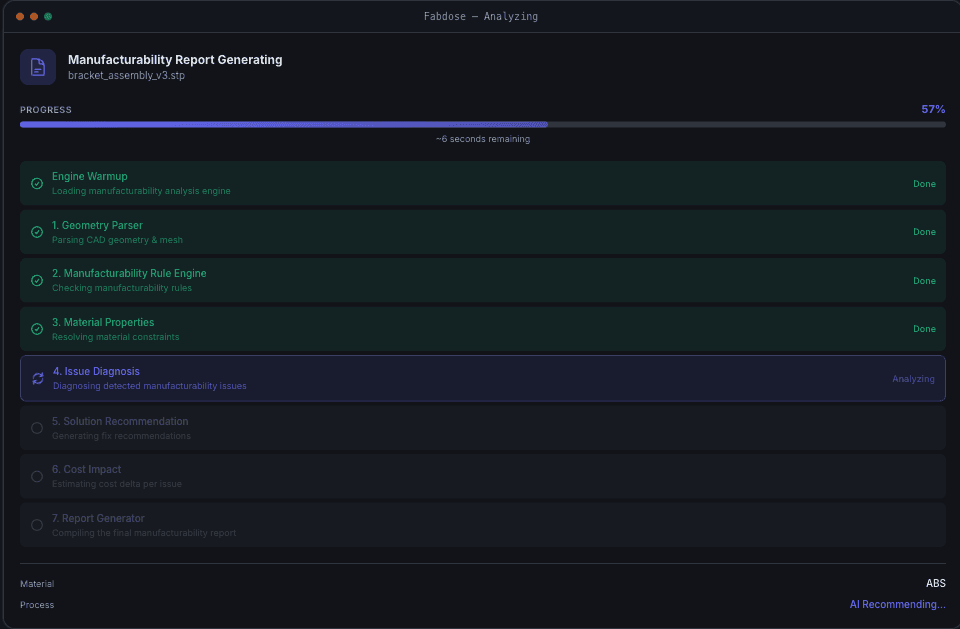
Fabdose runs analysis directly on the STEP file on your computer. Your CAD files are never uploaded; only the defect findings are processed by AI and synced to your account.
The analysis engine loads the geometry, builds a representation of the part topology, and runs checks against configurable process constraints. Wall thickness is estimated from the part's shell geometry, and the part is flagged when its minimum wall falls below the process threshold. Draft angle is computed per face against a specified pull direction. Undercuts are detected by analyzing which faces would be trapped by the mold geometry.
The output is specific: locations, measurements, and which check triggered the flag. Not general advice about what to watch out for, but a report of what your actual part has.
This is the distinction that matters for a product designer on a real schedule. You are not looking for an education in DFM principles. You are looking for a fast answer to a specific question: does this version of the part have any geometry that will cause a manufacturing problem?
Tip
Your CAD files are never uploaded — your STEP and STP files stay on your computer throughout the analysis. The defect findings are processed by AI and synced to your account.
The honest comparison
| What you want to know | ChatGPT | Fabdose |
|---|---|---|
| What are typical draft angle requirements? | Yes | Reference docs |
| Is my minimum wall thickness within the threshold? | No - cannot measure from STEP | Estimated from shell geometry, flagged if below |
| Which specific faces have insufficient draft? | No - no geometry access | Yes - per-face report |
| Where are my undercuts relative to pull direction? | No - cannot analyze topology | Yes - with pull direction config |
| What DFM rules apply to injection molding? | Yes | Yes |
| Can I keep my STEP file on my computer? | Upload not parsed anyway | Yes - local-first |
ChatGPT is a good starting point for learning DFM. It is not a substitute for actual geometric analysis when you need to know whether your specific part is ready to send to a shop.
Frequently asked questions
Can ChatGPT read or open a STEP file?
No. ChatGPT is a language model that processes text and images. A STEP file is a geometric database containing precise coordinate data, B-rep topology, and surface normals. When you paste a STEP file's text content into ChatGPT, it reads the AP203 or AP214 entity definitions as raw text and cannot reconstruct the 3D shape from those definitions.
Can I upload a STEP file to ChatGPT's file upload feature?
Yes, you can upload the file. But ChatGPT still cannot perform geometric computations on it. It can acknowledge the file's content as text and offer general observations about entity types, but it cannot measure wall thickness, detect undercuts relative to a pull direction, or evaluate draft angles from the actual surface data.
What is the difference between DFM advice and a DFM analysis?
DFM advice provides general manufacturing rules and heuristics — for example, that injection-molded parts typically need 1 to 3 degrees of draft. A DFM analysis applies those rules to the specific geometry of your part, flagging which faces fail the draft check and at what angle. ChatGPT provides advice. Geometry-analysis software provides analysis.
Is there a desktop tool that analyzes STEP files for manufacturability locally?
Yes. Fabdose is a local-first desktop app that loads STEP and STP files directly on your computer. Your files are never uploaded — only the defect findings are synced. The analysis runs in one to three minutes and produces a report with per-face findings, severity ranking, and a 3D viewer with issue pins.
How accurate is a geometry-based DFM analysis compared to factory feedback?
A geometry-based first-pass analysis catches rule-based issues — draft violations, wall thickness under threshold, undercut locations — reliably. It does not replace a manufacturing engineer's judgment on material-specific edge cases, regional tooling constraints, or production volume tradeoffs. The goal is to find the obvious geometry problems yourself before the part reaches a shop or consultant.
Analyze your STEP file on your computer. Your CAD file is never uploaded.
Download Fabdose Free